31%
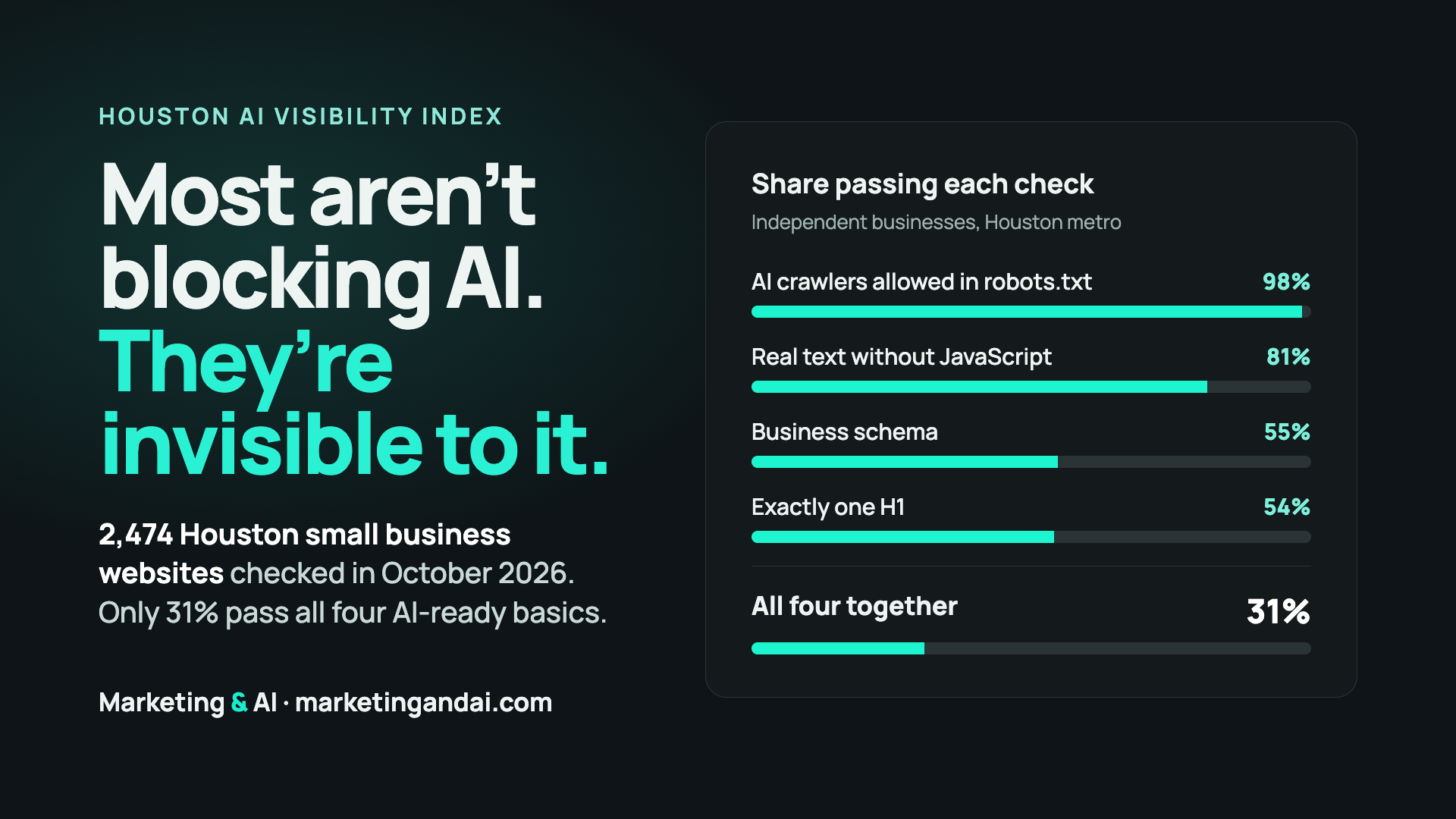
pass all four AI-ready basics. AI search crawlers allowed, real text without JavaScript, business schema, and exactly one H1.
Independents Let’s talk
Research / Houston AI Visibility Index
How visible are Houston small businesses to AI search? We checked 2,474 independent Houston-area business websites in October 2026. Only 31% pass four basic checks that let AI search tools find, read, and identify a business. The gaps are structure, not blocking: 45% have no business schema, 27% have no H1, and 19% show under 120 words without JavaScript. About 5% block AI search crawlers, counting both robots.txt and firewalls.
The Index looks at what ChatGPT, Claude, Perplexity, Copilot, and Google AI Overviews can actually fetch and understand on a business homepage. It is a technical snapshot, not a ranking or traffic study.
01 / Key findings
Shares of independent Houston-area business homepages. Bases differ slightly: robots.txt figures use sites whose robots.txt could be read; content figures use homepages we could fetch (2,017).
pass all four AI-ready basics. AI search crawlers allowed, real text without JavaScript, business schema, and exactly one H1.
Independentshave no business schema. Nothing in the code states the business name, address, and phone in the standard format search engines and AI tools read.
Independentshave no H1 at all. The page never states its main topic in a heading, which leaves AI tools to guess what the business does.
Independentsshow under 120 words without JavaScript. Most AI crawlers, including GPTBot, ClaudeBot, and PerplexityBot, do not run JavaScript, so these homepages look nearly empty to them. Among restaurants it is 33%.
Independentsblock AI search crawlers. Only 1.6% do it in robots.txt, but a follow-up test found about 3.8% more turn the crawlers away at the firewall. Still far smaller than the content and structure gaps.
Independentspublish an llms.txt file. Higher than expected. Several carry SEO-plugin signatures (for example Rank Math), so many are likely generated automatically.
Independents02 / By industry
Industries with at least 25 sites in the sample. Smaller groups are in the downloadable data. Restaurants get their own page: every check and a part-of-town breakdown for Houston restaurants.
| Industry | Sites | AI-ready basics | Under 120 words without JS | Business schema | Blocks an AI search crawler |
|---|---|---|---|---|---|
| Restaurants & food | 767 | 24% | 33% | 52% | 2.1% |
| Retail | 445 | 26% | 18% | 51% | 2.0% |
| Health & dental | 382 | 41% | 5.1% | 62% | 0.6% |
| Professional services | 320 | 49% | 8.2% | 67% | 1.6% |
| Home services & trades | 149 | 43% | 11% | 66% | 1.6% |
| Other | 132 | 16% | 11% | 32% | 1.8% |
| Beauty & personal care | 131 | 18% | 29% | 46% | 1.0% |
| Auto | 108 | 32% | 11% | 55% | 1.3% |
| Education & childcare | 40 | 21% | 12% | 46% | 0.0% |
03 / Independents vs chains
Chains and national brands (540 sites) were counted separately so they do not skew the small-business figures.
| Check | Independents | Chains & brands |
|---|---|---|
| Pass all four AI-ready basics | 31% | 29% |
| Under 120 words without JavaScript | 19% | 25% |
| Business schema present | 55% | 48% |
| Block at least one AI search crawler | 1.6% | 1.1% |
| llms.txt published | 30% | 22% |
| Exactly one H1 | 54% | 61% |
| Missing meta description | 23% | 12% |
Update / October 3, 2026
A reader pointed out that a site can allow a crawler in robots.txt and still block it at the firewall. So we tested it.
We took a random sample of 400 Index sites that allow every AI crawler in robots.txt and fetched each homepage with a normal browser and with each AI crawler's user agent (367 gave the browser a real page).
Caveat: we sent each crawler's user agent from our own network, not from the crawler's own IP addresses. Some firewalls let verified crawlers through and only block impostors, so the real figure may be lower. Server logs are the way to confirm it for a specific site.
04 / What to fix first
These map one-to-one to the AI-ready basics. Most take a developer an afternoon, not a rebuild.
05 / Method
One homepage per business, fetched once, using the same engine as our public scanner.
06 / Data & citation
The aggregate data is free to reuse with attribution under CC BY 4.0. No individual business is named in it.
Archived with a permanent DOI on Zenodo, and also published on Hugging Face and Kaggle.
Cite as: Marketing & AI (2026). Houston AI Visibility Index, October 2026 [Data set]. Zenodo. https://doi.org/10.5281/zenodo.23130268
Business listings © OpenStreetMap contributors, available under the Open Database License.
07 / Embed
Free to republish under CC BY 4.0. Paste the code below into any page or post; it keeps the credit line that the license asks for.
Next / Your site
Run the same checks on your own page in about ten seconds, free, or book a 30-minute audit and we will walk you through the fixes.
Questions
We checked 2,474 independent Houston-area business websites in October 2026. Only 31% pass four basic checks that let AI search tools find, read, and identify a business. The gaps are structure, not blocking: 45% have no business schema, 27% have no H1, and 19% show under 120 words without JavaScript. About 5% block AI search crawlers, counting both robots.txt and firewalls.
19% of independent Houston homepages show under 120 words before JavaScript runs. Most AI crawlers, including GPTBot, ClaudeBot, and PerplexityBot, read the raw HTML and do not run scripts, so content added by JavaScript is invisible to them.
No. GPTBot collects training data. ChatGPT search uses OAI-SearchBot and ChatGPT-User. Blocking GPTBot opts out of training; blocking OAI-SearchBot can keep a site out of ChatGPT search answers.
It is a cheap extra, not a fix. In our data, sites that publish an llms.txt pass the four basics more often (43% against 26% without one), most likely because someone there already pays attention to SEO. But 57% of sites with an llms.txt still fail the basics, and they are just as likely to show almost no text before JavaScript runs (17% against 19%). Fix crawler access, readable text, business schema and headings first; add an llms.txt after.