
Research / Houston AI Citation Study / Who goes first
Who goes first
in an AI answer?
How do AI engines decide which business to list first? Only Google AI Mode followed a business metric in our Houston data: it listed the business with more Google reviews and a higher star rating first (1.32 times as likely per doubling of reviews, 1.20 times per extra 0.1 star). For Perplexity, ChatGPT and Claude, nothing we measured about the business predicted the order, yet it held on a re-ask: minutes later Perplexity kept the same first pick 82% of the time, Claude 56% and ChatGPT 38%. In all four engines, a business that other engines also name tends to be listed earlier.
This is part of the Houston AI Citation Study, which asked 232 local questions to four AI engines. The consensus study asked which businesses all four engines name; this page asks what happens inside the answer: the order of the picks, what the engines write about them, and whether any of it can be predicted.
01 / Who goes first
Who goes first,
and what we still can’t see.
The consensus study asked who gets named. This section asks about order: which business an engine lists first, whether it keeps that slot when asked again, and how much of a business’s pull our measurements explain. It uses the first-run answers to the 120 questions, the second run minutes later, the November 6 re-ask, and the 398 businesses in the 21 markets’ Google Maps top 20. These findings are exploratory, with 109 tests corrected together.
- 1. Google AI Mode lists the better-reviewed business first. Using the rating and review count on AI Mode’s own cards, the business it listed higher had more Google reviews in 62% of pairs and a higher star rating in 60% (50% would mean the order ignores them). Fitted together, each doubling of reviews made a business 1.32 times as likely to be listed above another (95% CI 1.14 to 1.59), and each extra 0.1 star 1.20 times (1.02 to 1.46). It is a lean, not a sort: 19% of AI Mode’s lists were in exact star order, against 17% by chance, and it did not follow Google Maps order. For Perplexity, ChatGPT and Claude, nothing we measured about the business predicted the order: not Maps position, reviews, rating, Yelp, cited list sites, web authority or domain age (lowest corrected q 0.21). A model of the full order agreed: Maps position (odds ratio 1.27 per halving of the rank number, 0.96 to 1.57) and review standing (0.85, 0.56 to 1.22) did not reach significance. One pattern held in all four engines: a business that other engines also name is listed earlier, in 60–66% of pairs, which repeats finding 2 of section 02.
| Trait | AI Mode | Perplexity | ChatGPT | Claude |
|---|---|---|---|---|
| Named by more of the other engines | 60% | 66% | 65% | 60% |
| Google review count (AI Mode’s own card) | 62% | – | – | – |
| Google star rating (AI Mode’s own card) | 60% | – | – | – |
| Google Maps position* | 57% | 59% | 62% | 54% |
| Google review count* | 46% | 53% | 58% | 45% |
| Google star rating* | 72% | 56% | 55% | 57% |
| Yelp review count* | 55% | 42% | 53% | 39% |
| Cited list sites it is on* | 52% | 59% | 64% | 41% |
| Web authority (Common Crawl)* | 46% | 53% | 60% | 36% |
| Domain age* | 51% | 55% | 48% | 41% |
| Alphabetical order (a control) | 54% | 53% | 52% | 49% |
- Share of pick pairs in the same answer where the business listed first is also higher on the trait; 50% means the order ignores it. Bold: significant after correction across this section’s 109 tests (q under 0.10). Rows without an asterisk use all 120 questions; rows with one use the businesses in the 21 markets’ Google Maps top 20 on November 6, so they cover fewer pairs.
- 2. The order holds when you ask again, and the #1 slot holds best. Asked the same question a few minutes later, Perplexity kept the same first pick in 82% of answers, Claude in 56% and ChatGPT in 38%. If each engine had shuffled the businesses it named, that would happen 21%, 13% and 12% of the time. The first slot is the stickiest in all three, and a first pick that three or four engines name is steadier still: 94% against 77% for Perplexity, 67% against 54% for Claude and 54% against 31% for ChatGPT. So the order is not noise, even though no business metric explains it: something stable inside each engine sets it, and it cannot be read from the outside.
| Engine | Same #1 minutes later (95% CI) | #1 by chance | #2 in the same slot | #3 in the same slot | Order of businesses named both times | Same #1 a week later |
|---|---|---|---|---|---|---|
| Perplexity | 82% (74–88) | 21% | 65% | 55% | 89% | 62% |
| Claude | 56% (47–65) | 13% | 35% | 26% | 76% | 43% |
| ChatGPT | 38% (30–48) | 12% | 18% | 14% | 67% | 47% |
- 3. Engines agree on the #1 more than on the rest of the order. For every pair of engines we compared first picks on the questions both answered. They named the same #1 1.7–3.0 times as often as they would if each had ordered its own picks at random. The strongest pair was Google AI Mode and ChatGPT: the same first pick in 16 questions, against 5.4 expected. Below the top slot, agreement fades: when two engines named the same businesses, the pairs without AI Mode put them in the same order only 48–54% of the time (50% is chance) and the pairs with AI Mode 64–70%, not significant after correction.
| Engines | Same #1 | Expected by chance | Times chance | Same order below #1 |
|---|---|---|---|---|
| AI Mode + ChatGPT | 16 of 105 | 5.4 | 3.0× | 64% |
| ChatGPT + Claude | 11 of 114 | 4.4 | 2.5× | 54% |
| Perplexity + ChatGPT | 14 of 115 | 6.4 | 2.2× | 48% |
| Perplexity + Claude | 11 of 119 | 5.9 | 1.9× | 54% |
| AI Mode + Claude | 8 of 107 | 4.4 | 1.8× | 67% |
| AI Mode + Perplexity | 10 of 108 | 5.8 | 1.7× | 70% |
- 4. Claude’s #1 is often a business Google Maps doesn’t show for the search. For each of the 21 markets we have the Google Maps top 20 for the exact search. 37% of Claude’s picks there were not among them, and neither were 8 of its 21 first picks; AI Mode’s first pick was outside the top 20 in 1 market. Picks from outside the top 20 were rarely shared: another engine named them 12–18% of the time, against 66–77% for picks inside it. Several of Claude’s first picks sit in a neighbouring area, and one veterinary clinic was its first pick for two different suburbs. Two thirds of Claude’s citations are best-of list pages (67%, against 5% for AI Mode), and those lists reach beyond the map.
| Engine | Picks outside the top 20 | First picks outside | Also named by another engine: outside | Inside the top 20 |
|---|---|---|---|---|
| Google AI Mode | 19% | 1 of 21 | 16% | 76% |
| Perplexity | 30% | 4 of 21 | 18% | 73% |
| ChatGPT | 21% | 2 of 21 | 18% | 66% |
| Claude | 37% | 8 of 21 | 12% | 77% |
- 21 consensus markets, first-run answers. Names that share a distinctive word with a top-20 business, and picks named after a person, are counted as inside, so the first two columns are conservative. The last two columns use every pick not matched to the top 20.
- 5. Your own site and the news get you a second engine; directories alone do not. Perplexity, ChatGPT and Claude list the pages that support each pick. When a pick was supported by the business’s own website, another engine also named it more often: 1.65 times as often for Perplexity (95% CI 1.10 to 2.48) and 3.18 times for Claude (1.89 to 5.36), with position in the answer held fixed. A news or media page as support: 3.17 times across engines. Picks supported by directories were shared less often (Perplexity 0.52 times as often, Claude 0.62), and picks whose sources we could not identify much less. Claude’s own top slot runs the other way: its #1 is more often backed by directories (1.77 times) or the press (3.57), and less often by the business’s own site (0.48). Google AI Mode picks without a Business Profile card were named by another engine 21% of the time, against 44% with one (a lead; 19 picks). This is the other side of finding 2 in section 03: when an engine reads a business’s own site, the other engines are more likely to agree.
| Supporting page | Perplexity | ChatGPT | Claude | All engines |
|---|---|---|---|---|
| The business’s own website | 1.65× | 1.20× | 3.18× | 2.28× |
| A news or media page | 3.13× | 2.65× | 1.34× | 3.17× |
| A directory or list site | 0.52× | 1.05× | 0.62× | 1.15× |
| A source we could not identify | – | 0.29× | 0.26× | 0.39× |
- Odds ratios, clustered by question. Bold: the 95% interval excludes 1. Google AI Mode is left out because it lists a Google page for most picks.
- 6. About half of what makes a business a steady pick is still unmeasured. Across 398 Maps businesses and four engines, 62% of the variation in being named belongs to the business: the engines lean the same way about the same businesses. 38% is each engine’s own taste, and the market almost none. In plain numbers, when one engine names a business from the Maps top 20, each other engine names it 52–58% of the time, against 17–20% for a random business in the same market. The four signals explain about half of that business-level part (52%; a linear check gives 43%), and all 11 off-site factors together 51–62%. So roughly 40–50% of what makes a business every engine’s pick is something this study did not measure. Candidates include brand searches, press history, how consistently the business is described across the web, and what each engine happened to retrieve.
- 7. A star floor, not a star ladder. None of the 8 Maps businesses rated under 4.0 stars was named by any engine, against 33–44% in every band above 4.0 (Fisher p = 0.06; a lead, given eight businesses). They were not obscure: a median of 142 reviews and Maps position 10. Above the floor, a higher rating did not raise the odds of being named, and the lowest-rated business any engine named had 4.0 stars. Review volume has a softer floor: only 4.5–9.8% of each engine’s picks had fewer than 50 Google reviews, against 17.8% of the market.
- Reading more lists doesn’t make engines agree. 67% of Claude’s citations are best-of list pages and 5% of AI Mode’s, yet neither the best-of share, the directory share, the business-site share nor the number of distinct sites an answer cited predicted whether its picks were named by another engine (odds ratio 0.97 per 25 points of best-of share, 95% CI 0.84 to 1.11).
02 / Seven more patterns
Seven more patterns,
in the same answers.
We went back to all 120 recommendation questions and the 399 businesses in the 21 markets of the consensus study. Each pattern was checked for the most likely artifact, but they are follow-up findings: they were not part of the consensus study’s corrected 66-factor test.
- 1. Maps #1 is worth far more than #3. 38% of businesses at #1 in Google Maps were named by all four engines, 25% at #2 and 10% at #3. Below the top 3 it was under 3%. Google AI Mode named 67% of #1 businesses and 40% of those at #2 and #3. The small rise at #11–20 is the list-carried picks.
| Maps position | Businesses | Named by at least one engine | Named by all four | Named by Google AI Mode |
|---|---|---|---|---|
| #1 | 21 | 76% | 38% | 67% |
| #2 | 20 | 70% | 25% | 40% |
| #3 | 20 | 65% | 10% | 40% |
| #4–5 | 40 | 55% | 2.5% | 25% |
| #6–10 | 100 | 35% | 1.0% | 15% |
| #11–20 | 197 | 16% | 3.0% | 5% |
- 2. The first name an engine gives is the one that holds. An engine’s first pick was also named by another engine 48–55% of the time, against 17–27% for its sixth pick or later, and the gap held inside the same answer. First picks also survived a re-ask: minutes later, Perplexity named its first pick again 96% of the time and its sixth-or-later pick 64%; Claude 82% against 31%; ChatGPT 64% against 32%. A pick that only ChatGPT made was kept 40% of the time. Track the position you are named in, not just whether you are named.
| Position in the answer | Shared: AI Mode | Shared: Perplexity | Shared: ChatGPT | Shared: Claude | Kept: Perplexity | Kept: ChatGPT | Kept: Claude |
|---|---|---|---|---|---|---|---|
| 1st | 51% | 55% | 52% | 48% | 96% | 64% | 82% |
| 2nd | 48% | 45% | 45% | 34% | 88% | 56% | 79% |
| 3rd | 34% | 40% | 38% | 30% | 84% | 46% | 74% |
| 4th–5th | 39% | 25% | 28% | 35% | 68% | 42% | 60% |
| 6th or later | – | 27% | 21% | 17% | 64% | 32% | 31% |
- 3. Website checks cannot predict a pick. We trained a model on 20 markets and asked it to pick out the named businesses in the 21st, once for each market. The score is how often a named business ranks above an unnamed one in the same market, so 0.5 is a coin flip. The 44 website checks scored 0.50, no better than the same model trained on shuffled labels. Seven Google Business Profile fields scored 0.77 for being named by any engine and 0.86 for all four.
| Factors | Named by any engine | Named by all four |
|---|---|---|
| 44 website, schema and social checks | 0.50 (0.44 to 0.57) | 0.44 (0.33 to 0.54) |
| Link authority, domain age, Wikidata, chain, name | 0.56 (0.46 to 0.65) | 0.62 (0.50 to 0.73) |
| 7 Google Business Profile fields | 0.77 (0.69 to 0.85) | 0.86 (0.74 to 0.94) |
| The four signals | 0.77 (0.74 to 0.81) | 0.88 (0.78 to 0.95) |
| The four signals without lists | 0.73 (0.67 to 0.78) | 0.86 (0.76 to 0.94) |
| Everything off the website (11) | 0.80 (0.75 to 0.85) | 0.85 (0.71 to 0.97) |
| Off-site plus the website checks (55) | 0.77 (0.72 to 0.82) | 0.91 (0.83 to 0.96) |
- 4. AI Mode is usually the last engine to agree. When ChatGPT, Claude and Perplexity all named a business, AI Mode joined them 42% of the time, against 52–63% for the others. It names fewer businesses per answer, and 5 of the 6 businesses in these markets named by every engine except AI Mode were outside the Maps top 3.
- 5. Short lists turn into picks; long directories do not. On cited pages naming one to three of a market’s Maps top 20, 78% of those businesses were named by an engine and 33% by all four. On pages naming seven or more, it was 41% and 10%; businesses on no cited page, 13%. Birdeye (14 of 16), MapQuest (12 of 13) and Expertise.com (6 of 8) turned into picks most often, MedicalSpaLocator (7 of 26) least. The engines read these pages, so this is partly how a pick is made; it still shows where outreach pays.
- 6. Franchise locations get passed over. With the same four signals, a chain or franchise location was less than half as likely to be named as an independent in the same market (odds ratio 0.40, 0.20 to 0.80), and it held with multi-location brands removed. Five of the eight never-named businesses with three or four of the signals were chain locations, including one market’s review leader and a Maps #1 med spa. One exploratory test, so read it as a lead.
- 7. The engines agree on about one pick in five. When one engine named a business, any other given engine named it too 15–24% of the time. Agreement was highest in auto repair, gyms and veterinarians (27–30% of picks shared) and lowest for realtors (10%). Chiropractors, roofers, hair salons and realtors had no business named by all four engines in any of their eight areas.
03 / What the engines say
What the engines say,
and where it comes from.
We read what the engines wrote about each business they named (1,204 descriptions) and tested 22 factors we had not measured before. These findings are exploratory and were not part of the consensus study’s corrected 66-factor test.
- 1. Engines repeat what your homepage says. When a business’s homepage said how long it had been around, the engine’s description mentioned it 29% of the time, against 8% when it did not. Awards: 23% against 7%. Prices: 26% against 12%. Licenses and certifications were rarely mentioned either way. Then we traced the founding years. 21 answers quoted one; for the 16 where we could read the business’s homepage, all 16 matched it, and 10 of those years appeared on no cited third-party page near the business’s name. This shapes what is said about a business, not whether it is named.
| Fact | Homepage states it | Homepage does not | Odds ratio (95% CI) |
|---|---|---|---|
| Years in business | 29% | 8% | 4.6 (2.5 to 8.5) |
| Awards or ‘best of’ | 23% | 7% | 4.9 (2.2 to 11.2) |
| Prices | 26% | 12% | 2.4 (1.2 to 5.1) |
| Licenses, certifications | 6% | 5% | 1.3 (0.4 to 3.6) |
- 2. When Perplexity reads your site, it describes you in your own terms. Perplexity cited the recommended business’s own website for 47% of its October picks; Google AI Mode for 3.3%. With the site cited, Perplexity mentioned years in business 32% of the time (against 18%), specialties 42% (22%), licenses 17% (7%) and guarantees 9% (3%). Without it, Perplexity fell back on a star rating (47% against 27%) and a review count (42% against 23%).
| Mentioned in the description | Own site cited | Not cited | Odds ratio (95% CI) |
|---|---|---|---|
| Years in business | 32% | 18% | 2.2 (1.4 to 3.5) |
| Specialties, services | 42% | 22% | 2.5 (1.7 to 3.9) |
| Licenses, certifications | 17% | 7% | 2.6 (1.5 to 4.6) |
| Hours, emergency, same-day | 18% | 8% | 2.4 (1.3 to 4.6) |
| Guarantee, warranty | 9% | 3% | 3.2 (1.5 to 6.9) |
| Star rating | 27% | 47% | 0.4 (0.2 to 0.6) |
| Review count | 23% | 42% | 0.4 (0.3 to 0.6) |
- 3. The review counts engines quote are mostly not Google’s. Only 5% of the review counts Claude quoted on November 6 were within 10% of the business’s Google count. The median was 21% of Google’s, and 54% of those sentences named Yelp or another platform. Perplexity’s counts matched Google 35% of the time in October and 27% in November. Google AI Mode matched 97%, because it repeats Google’s own card, and ChatGPT quoted no star ratings or review counts in its 78 picks. The numbers Claude and Perplexity repeat come mostly from Yelp and trade review sites, so keep those profiles current.
| Engine | Ratings quoted | Rating matches Google | Review counts quoted | Count within 10% of Google | Count lower than Google | Median count vs Google |
|---|---|---|---|---|---|---|
| Google AI Mode, Oct 30 | 232 | 96% | 134 | 97% | 2% | 100% |
| Perplexity, Oct 30 | 38 | 61% | 34 | 35% | 53% | 85% |
| Perplexity, Nov 6 | 26 | 62% | 22 | 27% | 59% | 43% |
| Claude, Nov 6 | 36 | 22% | 37 | 5% | 84% | 21% |
| ChatGPT, Nov 6 | 0 | – | 0 | – | – | – |
- 4. Each engine explains its picks its own way. Google AI Mode uses service-quality words such as “friendly” and “honest” in 49% of descriptions. Perplexity mentions years in business (24%), awards (16%) and licenses (12%) more than any other engine. Claude quotes review counts (52%) and what reviewers say (29%). ChatGPT names the site it took the information from (78%) and never quotes a star rating or review count.
- 5. The first pick gets twice the words. An engine’s first pick got a median of 44 words, against 22 for its fourth pick or later. Being named by all four engines barely changed the wording: no kind of fact differed in October, and the two November differences (rankings and awards 22% against 6%; 40 against 28 words) are leads only.
- 6. Engines don’t agree because they read the same pages. Across the 120 questions, two engines that cited more of the same third-party sites did not name more of the same businesses (−0.1 points of pick overlap per 10 points of site overlap, 95% CI −0.9 to 0.8). An engine’s first pick was the first of its picks on its top-cited page 44% of the time, against 41% by chance. Agreement comes from the same businesses leading everywhere, not from copying one source, so being first on one list does not make you first in the answer.
- 7. 22 more website and profile factors: one lead. None separated the businesses all four engines named after correction. The one lead is the searched city in the domain, as with airtechofhouston.com and sugarlandpethospital.com: 26% of all-four picks had it, against 7% of never-named businesses (odds ratio 9.2, 95% CI 2.1 to 40.5, with review count and Maps position held fixed). A perfect 5.0 rating, a Google rating far above the Yelp rating, an out-of-area phone number, a profile link to an inner page, a current footer year and question-style headings made no difference. Person and founding-date schema went with being named by one or two engines, not all four.
| Kind of fact | AI Mode | Perplexity, Oct | Perplexity, Nov | ChatGPT | Claude |
|---|---|---|---|---|---|
| Star rating | 57% | 37% | 45% | 0% | 47% |
| Review count | 37% | 33% | 38% | 0% | 52% |
| What reviewers say | 27% | 4% | 2% | 4% | 29% |
| Service-quality words | 49% | 8% | 8% | 17% | 11% |
| Specialties, services | 45% | 31% | 41% | 33% | 22% |
| Location | 32% | 20% | 18% | 24% | 15% |
| Years in business | 13% | 24% | 20% | 13% | 11% |
| Awards, rankings | 10% | 16% | 12% | 8% | 11% |
| Price, fees | 14% | 16% | 26% | 17% | 9% |
| Licenses, certifications | 4% | 12% | 10% | 1% | 5% |
| Names its source | 9% | 20% | 20% | 78% | 39% |
| Descriptions | 420 | 513 | 84 | 78 | 109 |
04 / What sets the order
Ten suspects,
one confirmed.
Section 01 shows the order is stable for Perplexity, ChatGPT and Claude, yet nothing about the business explains it. This section tests ten candidate explanations, puts the one that survived through a pre-registered test on new answers, and then asks what a go-to is, where it comes from and whether it travels.
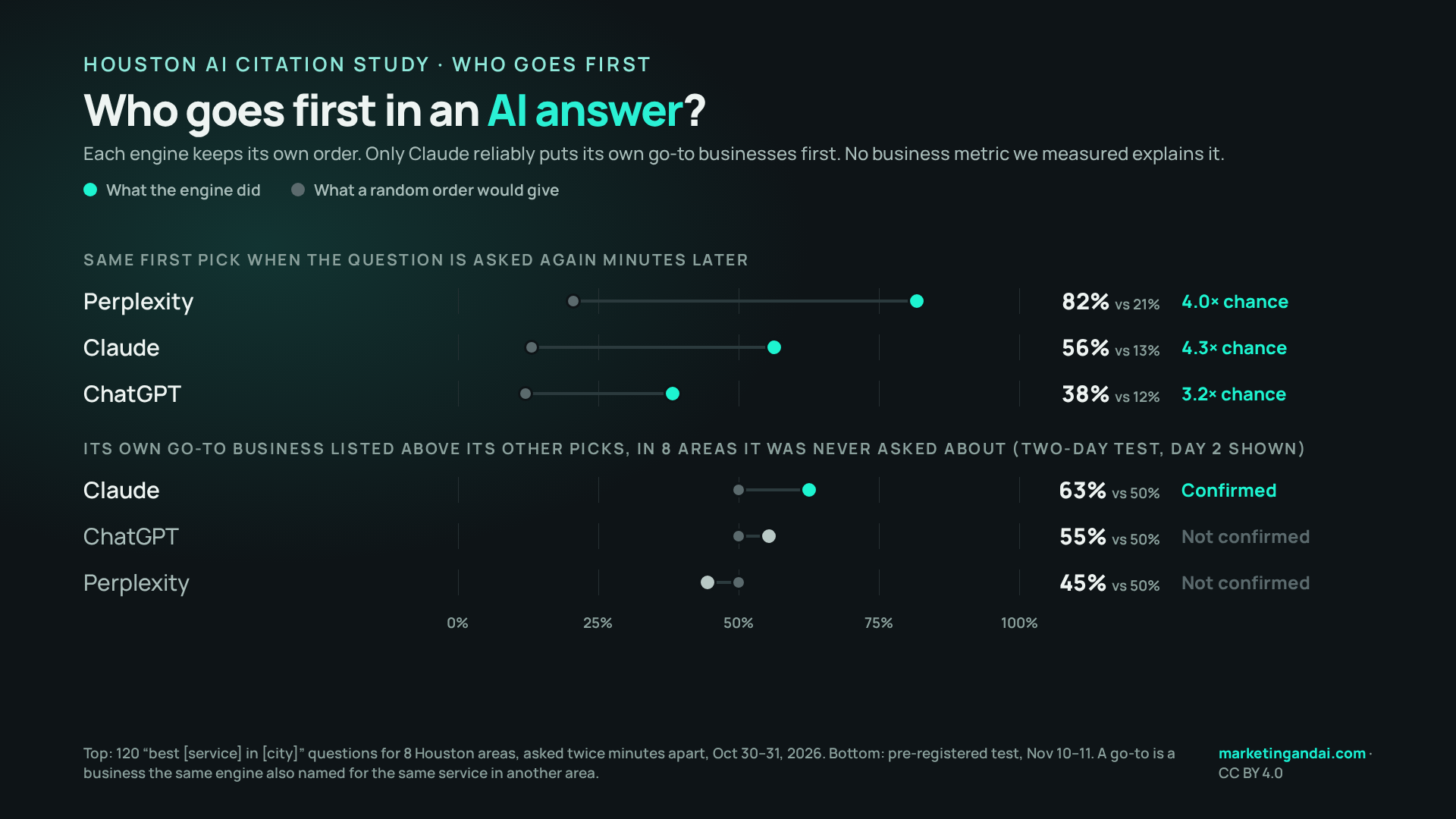
- 1. Ten suspects, none confirmed. Before looking, we wrote down ten things that might set the order for Perplexity, ChatGPT and Claude: Bing local position, Yelp rating, how many of the answer’s own cited pages name the business, the facts on its homepage, whether its name contains the service, whether its name contains the area, how many areas the brand is picked in, a Wikidata item, a mention on a cited news page, and being a chain. A variable passed only if it held on the first October run after correcting 39 tests together and again on the second run minutes later. No external variable passed. Brand footprint passed for Claude only while it counted Claude’s own picks, and failed once it was counted from the other engines.
- 2. One lead: each engine has its own go-to businesses. A go-to business is one the same engine also named for the same service in another area. In the October answers, ChatGPT, Claude and Perplexity listed their go-to businesses earlier than their other picks; Google AI Mode did not. We found this after the ten suspects failed, so it needed a test on new data with the rule fixed first.
| Engine | October run 1 | October run 2, minutes later | November 6 re-ask |
|---|---|---|---|
| ChatGPT | 70.2% of 168 pairs (p <0.001) | 62.8% of 180 pairs (p 0.017) | 86.5% of 37 pairs (p 0.001) |
| Claude | 61.4% of 518 pairs (p <0.001) | 55.6% of 574 pairs (p 0.08) | 50.5% of 105 pairs (p 1) |
| Perplexity | 60.6% of 226 pairs (p 0.0195) | 60.3% of 214 pairs (p 0.039) | 35.7% of 42 pairs (p 0.209) |
| Google AI Mode | 49.6% of 119 pairs (p 1) | – | – |
- 3. The test on new areas. We asked the same 15 questions for eight neighbouring areas the October study never covered (Pearland, Cypress, Missouri City, Tomball, Conroe, Baytown, League City and Kingwood) on two separate days, 120 answers per engine per day. Go-to status was fixed from the October answers, so the new answers could not define it. An engine passes only if the pattern holds on day 1 after correction (q below 0.10) and again on day 2 (p below 0.05). Google AI Mode was not re-asked.
| Engine | Day 1: go-to listed earlier | Day 2: go-to listed earlier | Day 1: first pick is a go-to vs a random order | Verdict |
|---|---|---|---|---|
| ChatGPT | 64.0% of 203 pairs (q 0.0112) | 55.4% of 224 pairs (p 0.26) | 43.2% vs 29.0% | FAIL |
| Claude | 60.4% of 603 pairs (q 0.0015) | 62.6% of 564 pairs (p <0.001) | 61.6% vs 40.5% | PASS |
| Perplexity | 50.2% of 227 pairs (q 1) | 44.5% of 211 pairs (p 0.268) | 26.4% vs 32.0% | FAIL |
- The verdict. Claude passes: in areas it had never been asked about it listed its go-to earlier on both days (60.4% and 62.6% of pick pairs). ChatGPT does not: it met the day-1 condition (64.0%) and missed day 2 (55.4%, p 0.26). The direction was the same on both days, but the rule was fixed in advance and it was not met, so for ChatGPT the lead is not confirmed. Perplexity does not on either day (50.2% and 44.5%). Items 4 to 9 below describe the October answers; read what they say about ChatGPT and Perplexity in that light.
- 4. It is the engine’s own favourite, and it works like a switch. We modelled the full order of each October answer with three things at once: whether the business is the engine’s own go-to, whether other engines name it in other areas, and how many other engines name it for the question. ChatGPT lists its own go-to earlier at odds of 2.08 on the first run and 1.68 on the second; Claude at 1.74 and 1.37. Both hold on both runs. Perplexity starts at 1.82 and does not hold on the second run (1.31, p 0.233). Being another engine’s go-to adds nothing for any of them. A wider footprint does not pull harder: a business the engine names in one other area is listed earlier about as strongly as one it names in two or more.
- 5. Each engine keeps its own list, and it is not a size ranking. Of 133 brands that are a go-to for at least one engine, 115 are a go-to for exactly one engine and 2 for all four. In the 21 markets with Google Maps data, a go-to is still listed earlier with Maps position, review standing, star rating, chain status and consensus held fixed (odds 2.08 (1.33–3.89)). The go-to businesses are mostly chains or multi-location brands (69% against 12% of other named businesses) with a median of 1,285 Google reviews against 421, yet fewer of them sit in the Maps top 3 (26% against 42%).
- 6. A go-to sets the place in the answer more than the place on the list. When the question was asked again minutes later, ChatGPT repeated 66.0% of its go-to picks against 50.8% of the rest and Claude 75.0% against 64.5%; with position and consensus held fixed neither difference is significant. Perplexity repeated its go-to picks less often (74.6% against 83.6%).
| Engine | Own go-to, run 1 (95% CI) | Own go-to, run 2 (95% CI) | Other engines’ go-to, run 1 | Other engines’ go-to, run 2 | Named in 1 other area | Named in 2+ other areas |
|---|---|---|---|---|---|---|
| ChatGPT | 2.08 (1.15–4.03), p 0.003 | 1.68 (1.10–2.93), p 0.0275 | 1.23 (0.77–2.14) | 0.81 (0.49–1.30) | 2.71 | 2.37 |
| Claude | 1.74 (1.27–2.58), p 0.001 | 1.37 (0.94–2.11), p 0.0315 | 0.92 (0.59–1.46) | 0.90 (0.60–1.31) | 1.73 | 1.62 |
| Perplexity | 1.82 (1.25–2.61), p 0.005 | 1.31 (0.91–1.99), p 0.233 | 0.80 (0.52–1.22) | 1.11 (0.68–1.71) | 1.87 | 1.58 |
- 7. Across October, November 6 and the new areas. Putting the three occasions together shows the same split as the verdict. Claude’s go-to is listed first in 57.5% of pick pairs using day 1 of the new areas and 58.0% using day 2, and its occasions agree with each other. ChatGPT pools to 67.7% and 65.8%, but with day 2 its occasions no longer agree (p 0.0273): 64.0% in the new areas on day 1 and 55.4% on day 2. Perplexity pools to 47.7%: no effect. In the new areas the pattern is clearest for metro-wide service trades (plumber, HVAC, roofer, realtor, injury lawyer, SEO agency), where a go-to is listed earlier on both days (odds 1.44 and 1.33); for storefront trades it is not significant on either day (1.12 and 1.27).
- 8. It is not the same page read twice, and not a pick made without a source. If an engine reached its go-tos by reading the same list page for every suburb, two of its answers that share a business would also share cited sites. They do not: answer pairs that share a business cite no more of the same third-party sites than pairs that do not, for any of the three engines. The same third-party page was cited in two areas for the same service 1 time out of 327 for ChatGPT, 0 out of 308 for Claude and 3 out of 603 for Perplexity. Nor is a go-to more often given with no supporting source: 37.7% against 31.1% for ChatGPT and 34.5% against 47.0% for Claude, neither significant. The engines read different pages for each suburb and still arrive at the same brands.
- 9. How steady each list is. 79.5% of the go-tos from Claude’s first run were go-tos again on the second, 72.4% of Perplexity’s and 52.6% of ChatGPT’s. With go-to status taken from the other run only, so that no answer helps define its own predictor, Claude still lists a go-to earlier on both runs (odds 1.68 and 1.51). ChatGPT does on the first run (2.23) and falls short on the second (1.45, p 0.0945), so under this stricter definition only Claude holds.
- 10. Go-tos travel to areas the engine was never asked about. The test above is about where a go-to is listed. A separate question is whether the engine names it at all. We took every brand an engine named for a service in October and asked whether the same engine named it in any of the eight new areas, on each of the two days. For brands named in one October area that is rare; for brands named in three or more it is the rule, for all three engines and on both days (table below). For Claude this is its own list and not a brand’s reach: with the other engines’ footprint for the same brand held fixed, each extra October area multiplies the odds by 6.19 on day 1 and 7.47 on day 2, the other engines’ footprint adds nothing on either day, and a go-to that no other engine names elsewhere travels as well as one they do. ChatGPT is different: its own footprint counts (5.02 and 6.93) and so does the other engines’ (1.70 and 1.96), so it mostly carries over brands that are widely known. Perplexity’s own footprint holds on both days; the other engines’ footprint showed on day 2 only (1.36, then 1.77). Being next door to an October area helps, but most go-tos that travelled reached at least one new area that is not next to any of their October areas (last column). It is a strong signal for a small group: go-tos are 4% to 11% of an engine’s brands, and ranked across all October brands the footprint scores 0.61 to 0.70 where 0.5 is a coin flip.
| Engine | Named in 1 October area | Named in 2 | Named in 3 or more | Odds per own area | Odds per other engines’ area | Go-to no one else names elsewhere | Go-tos reaching a non-neighbour area |
|---|---|---|---|---|---|---|---|
| ChatGPT | 5.3% / 5.5% of 678 | 21.7% / 39.1% of 23 | 87.5% / 87.5% of 8 | 5.02 / 6.93 | 1.70 / 1.96 | 9.1% / 18.2% of 11 | 8 of 12 / 12 of 16 |
| Claude | 11.9% / 8.3% of 662 | 43.6% / 45.5% of 55 | 91.3% / 82.6% of 23 | 6.19 / 7.47 | 1.09 / 1.01 | 58.3% / 58.3% of 36 | 25 of 45 / 28 of 44 |
| Perplexity | 5.3% / 5.1% of 550 | 39.1% / 43.5% of 23 | 83.3% / 66.7% of 12 | 7.89 / 5.39 | 1.36 / 1.77 | 60.0% / 53.3% of 15 | 11 of 19 / 12 of 18 |
05 / Method
How we tested.
Every number on this page comes from the downloadable tables.
- Answers: the 120 recommendation questions (“Who is the best [service] in [city], TX?”) from the Houston AI Citation Study, asked to Google AI Mode, Perplexity Sonar, ChatGPT search and Claude with web search on October 30–31, 2026, twice, minutes apart. The 21 markets and their 399 businesses are those of the consensus study.
- Answer order (section 01): the position of each pick in the first-run answers to the 120 questions (October positions from the study’s structured extraction; November positions are the order of first mention in the answer text). Pairwise concordance between position and each trait within each answer, with shuffled-order p-values and intervals from resampling answers; a joint rank-ordered logit for AI Mode’s card ratings and review counts, and another among Maps businesses for the other three engines; first-pick agreement between engines against a within-answer shuffle; re-ask persistence with Wilson intervals; supporting-page types per pick, with errors clustered by question; a mixed logistic model of 398 businesses × 4 engines with business and market random effects (variational Bayes, with a linear-probability check). Benjamini–Hochberg correction across the section’s 109 tests. Exploratory.
- Seven patterns (section 02): naming rates by Maps position and review rank; agreement and re-ask survival by position in the answer, with a conditional logit within each question; leave-one-market-out logistic models scored by within-market concordance, with intervals from resampling markets and a shuffled-label test; cited pages grouped by how many of a market’s businesses they name; a chain indicator with the four signals held fixed, with and without multi-location brands. They are exploratory and not corrected for multiple testing.
- Answer text (section 03): 1,204 descriptions of named businesses: Google AI Mode and Perplexity on all 120 questions (October 30), and Perplexity, ChatGPT and Claude on the 21 consensus questions (November 6; ChatGPT and Claude answer text was not stored in October). Each answer was split into sentences per business and coded for 16 kinds of fact with text patterns, checked by hand on samples; Google’s card fields were removed from AI Mode’s text first. Quoted ratings and review counts were compared with Google’s numbers for the same day, and quoted founding years were traced to homepages fetched without JavaScript. Shared sources: overlap of cited third-party sites against overlap of named businesses for each pair of engines within the same question. 22 new factors were tested with conditional logit within each market, corrected within that family. Exploratory.
- Order variables (section 04): ten candidate variables, written down with the engines each should show in before testing. Pairwise concordance between position and each variable within each answer, with shuffled-order p-values; Benjamini–Hochberg correction across the 39 first-run tests; a variable passed only with q below 0.10 on run 1 and the same direction with p below 0.05 on run 2.
- Go-to confirmation (section 04): rule, questions, areas and pass criteria were fixed in writing on November 10, 2026, before any confirmation answer was collected. The same collector, models and name rules as October; go-to status computed from the published October recommendation files only; no name was edited by hand. An engine with fewer than 30 informative pairs on a day would be reported as inconclusive. Day 2 re-asks the day-1 questions, so the two days are not independent samples.
- What a go-to is (section 04, items 4 to 7): seven questions and the same pass rule, written down before running. Rank-ordered logit of the full order of each answer; shuffled-order p-values (2,000); intervals from resampling answers or questions (1,000); Benjamini–Hochberg across 11 first-run tests, with the second run as replication. The three occasions are pooled with a random-effects model.
- Where a go-to comes from (section 04, items 8 to 10): checks and the pass rule written down before running. Cited third-party sites compared across pairs of answers for the same service, with the cited sites shuffled among areas for the p-value; per-pick sources with position held fixed; go-to status from the other run only. Carry-over to the eight new areas is a logistic model of being named, with the engine’s own footprint, the other engines’ footprint and the trade type together, standard errors clustered by service, and Benjamini–Hochberg correction across 15 tests on day 1; the same scripts were then run unchanged on the day-2 answers, and a result counts as replicated with the same direction and p below 0.05.
- Limits: One metro and wide intervals; these are associations, not proof that one change will move an engine. Sections 01 to 03 are exploratory. Section 01 compares October answers with Google Maps results from November 6, name matching can miss a business listed under another name, and the under-4.0 floor rests on eight businesses. Yelp, TripAdvisor, OpenTable and Yellow Pages pages could not be read without a browser. In section 04, brands are matched by name, so a business listed under a different name in another area is missed. The size check and the go-to profile in section 04 cover only the 21 markets with Maps data, and the profile counts a business once per engine. The other engines’ footprint stands in for a brand’s real service area and does not measure it, and the split of go-tos by whether other engines name them covers 11 to 42 brands per cell. Automated checks ran without JavaScript and were excluded from analytics.
06 / Data & citation
Use the numbers.
Free to reuse with attribution under CC BY 4.0. The tables are aggregates; values for individual businesses are not published.
Download the answer-order table (CSV)
- Who goes first (CSV): what predicts the order in each engine’s answers, re-ask persistence by slot, shared first picks, picks outside the Maps top 20, supporting pages and agreement, the variance split and rating floors, one value per row with q-values.
- Seven patterns (CSV): Maps position, answer position, re-ask survival, prediction scores, list size, chains and agreement by trade, one value per row.
- What the engines say (CSV): kinds of fact by engine, homepage facts and own-site citations, quoted numbers against Google, shared sources and list order, and the 22 new factors, one value per row.
- What sets the order (CSV): the ten order variables on both runs, go-to businesses in October and on the new areas, what a go-to is, where it comes from and whether it travels, one value per row with intervals.
Cite as: Rusic, A. (2026). Who goes first in an AI answer? Houston AI Citation Study follow-up, November 2026. Marketing & AI. https://marketingandai.com/research/houston-ai-citation-study/who-goes-first/
Next / Your business
Find out which engines name you.
Check your site against the basics in about ten seconds, free, or book a 30-minute audit and we will show you where you stand on all four signals for your service and city.
Questions
About the order of AI picks.
How do AI engines decide which business to list first?
Only Google AI Mode followed a business metric in our Houston data: it listed the business with more Google reviews and a higher star rating first (1.32 times as likely per doubling of reviews, 1.20 times per extra 0.1 star). For Perplexity, ChatGPT and Claude, nothing we measured about the business predicted the order, yet it held on a re-ask: minutes later Perplexity kept the same first pick 82% of the time, Claude 56% and ChatGPT 38%. In all four engines, a business that other engines also name tends to be listed earlier.
Does it matter where a business appears in an AI answer?
Yes. In our Houston data an engine’s first pick was also named by another engine about half the time, against 17–27% for its sixth pick or later, and first picks were the most likely to survive a re-ask: minutes later Perplexity named its first pick again 96% of the time. Track the position you are named in, not just whether you are named.
Where do AI engines get what they say about a business?
Mostly from the business’s own homepage and its review profiles. In our Houston data an engine mentioned a founding year 29% of the time when the homepage stated it and 8% when it did not, and every founding year we could trace matched the business’s homepage. Review counts were another matter: only 5% of the counts Claude quoted matched Google, most of them Yelp numbers. Keep your homepage facts and your Yelp page current.