Research / Houston AI Citation Study / Factors

Which AI citation factors
actually matter?

By Andres Rusic, Marketing & AI · Data collected · Updated

Which website factors make a local business more likely to be cited by AI search? We tested 40 commonly recommended factors on 880 Houston-area business websites: 492 that Google AI Mode or Perplexity cited and 388 in the same industries that they did not. Six held up in every test: a meta description, reviews or testimonials on the homepage, a specific business type in the schema, prices, years in business, and city pages. Most of the other factors went with citations only because sites that do one thing well tend to do many. Link authority was mixed, and page speed, domain age and firewall settings showed no clear link.

This is part of the Houston AI Citation Study, which traced 3,102 citations in Google AI Mode and Perplexity answers to 232 local questions. Here we ask what the cited websites had in common.

01 / Key findings

What separated cited sites from the rest.

880 Houston-area business homepages in 12 industries, crawled on October 30, 2026, the day the questions were asked. Odds ratios are adjusted for industry and link authority.

6 of 40

factors held up in every test. They were linked to citations on their own, kept their effect when all 40 were tested together, and pointed the same way inside the Houston census.

Both engines

33

factors were more common on cited sites, but 27 of them were explained by others. Business schema, FAQ schema, llms.txt and fresh sitemaps all went with citations, but none added anything once the other factors were known.

Both engines

14% vs 3%

of Houston census sites were cited with reviews or testimonials on the homepage, against without. The pattern held in all 11 industries where we could compare.

Census sites

0 of 82

census sites without a meta description were cited. 96% of cited sites had one, against 79% of sites that were not cited.

Census sites

2x

the readable text. The median cited homepage had 1,028 words readable without JavaScript, against 510 for sites that were not cited. Perplexity cared about this more than AI Mode.

Perplexity

None

of the website factors stood out for Google AI Mode. It cited only 51 of these sites, and its picks come from Google Business Profiles, so site factors explain Perplexity's citations far better than AI Mode's.

Google AI Mode

02 / The scorecard

40 factors,
one verdict each.

Share of cited and not-cited sites with each factor, or the median for counts. An odds ratio above 1 means sites with the factor were more likely to be cited.
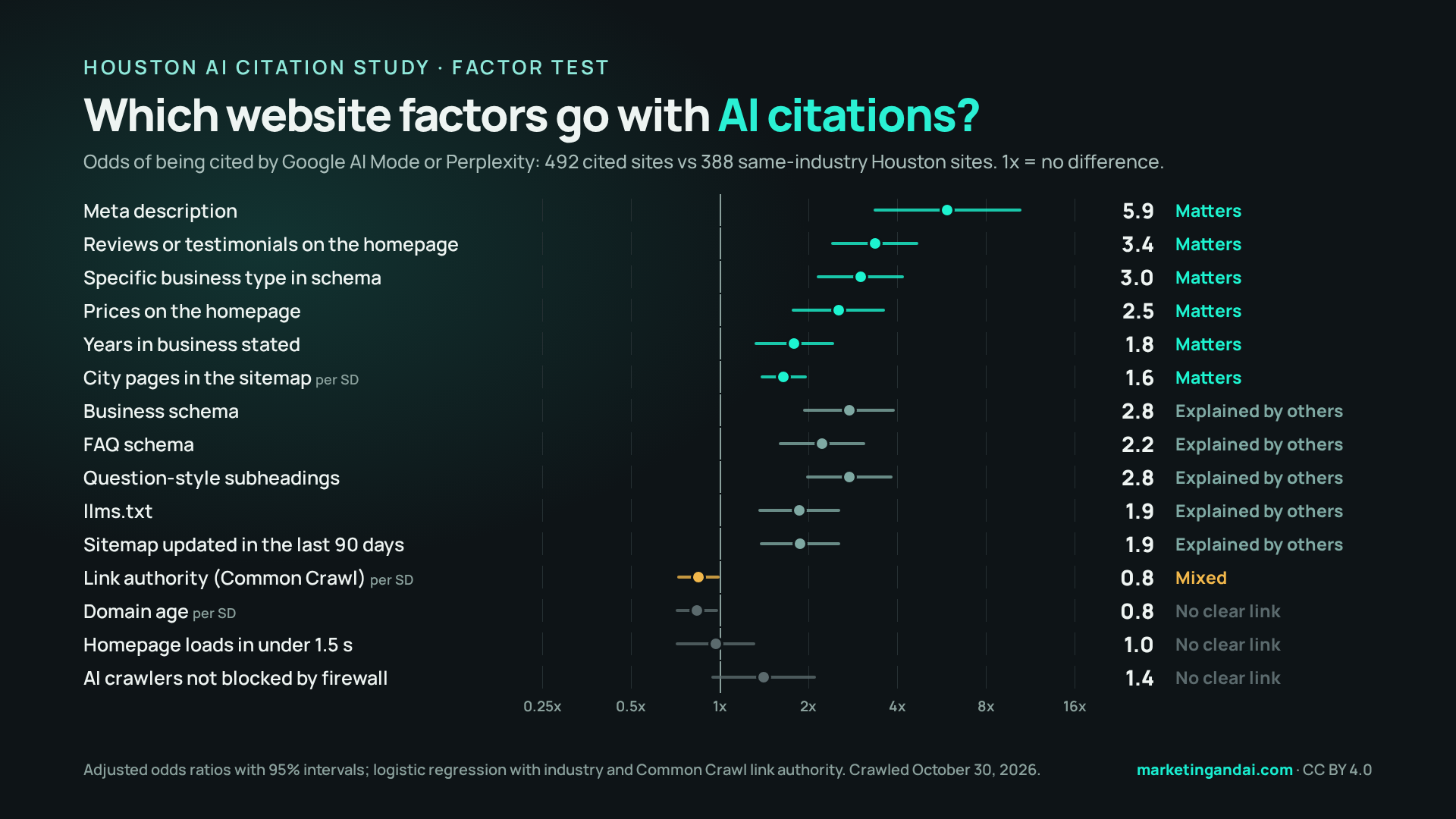
Adjusted odds of being cited by Google AI Mode or Perplexity for 15 website factors: meta description 5.9, reviews on the homepage 3.4, specific business type in schema 3.0, prices 2.5, years in business 1.8 and city pages 1.6 held up; business schema, FAQ schema, question-style subheadings, llms.txt and fresh sitemaps were explained by other factors; link authority was mixed; domain age, page speed and firewall settings showed no clear link
492 cited sites against 388 not-cited Houston sites in the same industries, October 30, 2026. Adjusted odds ratios with 95% intervals. CC BY 4.0.
Website factors and AI citations, cited sites against not-cited sites in the same industries
FactorCitedNot citedOdds ratio (95% interval)Verdict
Meta description96%79%5.9 (3.3 to 10.5)Matters
Reviews or testimonials on the homepage75%46%3.4 (2.4 to 4.7)Matters
Specific business type in schema (Dentist, Plumber...)55%33%3.0 (2.1 to 4.2)Matters
Prices on the homepage35%18%2.5 (1.8 to 3.6)Matters
Years in business stated53%36%1.8 (1.3 to 2.4)Matters
City pages in the sitemap69% (median 10)46% (median 0)1.6 per SD (1.4 to 2.0)Matters
Tap-to-call phone link91%66%4.2 (2.7 to 6.5)Explained by others
AI search crawlers allowed in robots.txt98%92%3.6 (1.6 to 7.9)Explained by others
Link to its Google Business Profile or Maps70%47%2.9 (2.1 to 4.1)Explained by others
Question-style subheadings69%43%2.8 (2.0 to 3.9)Explained by others
Business schema83%61%2.8 (1.9 to 3.9)Explained by others
Address and phone in schema69%45%2.6 (1.9 to 3.6)Explained by others
Opening hours in schema58%36%2.3 (1.7 to 3.2)Explained by others
Words readable without JavaScriptmedian 1,028median 5102.2 per SD (1.8 to 2.8)Explained by others
FAQ or Q&A schema46%25%2.2 (1.6 to 3.1)Explained by others
Exactly one H177%60%2.2 (1.6 to 3.1)Explained by others
Rating or review schema22%10%2.1 (1.3 to 3.3)Explained by others
Service or offer schema24%12%2.1 (1.4 to 3.2)Explained by others
sameAs profile links in schema62%43%2.0 (1.5 to 2.8)Explained by others
Houston-area place names on the homepagemedian 11median 41.9 per SD (1.6 to 2.3)Explained by others
Sitemap updated in the last 90 days68%47%1.9 (1.4 to 2.6)Explained by others
Links to directory profiles (Yelp, BBB...)29%18%1.9 (1.3 to 2.7)Explained by others
llms.txt published46%33%1.9 (1.4 to 2.6)Explained by others
Houston ZIP code in the text62%49%1.8 (1.3 to 2.4)Explained by others
Number of subheadingsmedian 19median 101.8 per SD (1.5 to 2.1)Explained by others
Blog55%36%1.7 (1.3 to 2.4)Explained by others
Licensed, insured or certified stated45%22%1.7 (1.2 to 2.5)Explained by others
List items on the homepagemedian 57median 291.7 per SD (1.4 to 2.0)Explained by others
Outbound links on the homepagemedian 10median 81.7 per SD (1.4 to 2.0)Explained by others
Current year (2026) on the page44%31%1.6 (1.1 to 2.2)Explained by others
Social profiles linkedmedian 2median 21.4 per SD (1.2 to 1.7)Explained by others
Modified date in page metadata47%35%1.4 (1.0 to 2.0)Explained by others
Sitemap sizemedian 81 URLsmedian 35 URLs1.4 per SD (1.2 to 1.6)Explained by others
Link authority (Common Crawl)same median rank0.85 per SD (0.72 to 1.00)Mixed
AI crawlers not blocked by a firewall85%81%1.4 (0.9 to 2.1)No clear link
Has a table6.5%4.9%1.7 (0.9 to 3.2)No clear link
Homepage responds in under 1.5 seconds60%63%0.97 (0.71 to 1.32)No clear link
Domain agemedian 10.2 yearsmedian 12.5 years0.84 per SD (0.71 to 0.99)No clear link
Wikidata entry1.0%2.1%0.93 (0.26 to 3.4)Too rare to test
HTTPS100%100%n/aEvery site had it
  • How to read the verdicts. "Matters" means the factor was linked to citations on its own, kept a stable effect when all 40 factors were tested together, and pointed the same way among Houston census businesses. "Explained by others" means it was linked on its own but added nothing once the other factors were in the model. Full numbers for every engine are in the downloadable data.

03 / The six that held up

Proof, prices and places
beat technical polish.

For each factor: how much more common it was on cited sites, and the share of Houston census sites cited with and without it.

  1. Reviews or testimonials on the homepage. 75% of cited sites showed them, against 46% of sites that were not cited (odds ratio 3.4). Among census businesses, 14.1% of sites that showed reviews were cited, against 3.2% that did not. It held in all 11 industries we could compare.
  2. A specific business type in the schema. Marking up the business as a Dentist, Plumber, Attorney or Veterinary Care, not just LocalBusiness or Organization, went with 3 times the odds of being cited. 15.3% of census sites with a specific type were cited, against 4.7% without. Having business schema of any kind was not enough on its own.
  3. Prices on the homepage. 35% of cited sites showed at least one dollar amount, against 18% of the rest (odds ratio 2.5). This matches the main study, where pricing pages and booking pages carried most business citations on cost questions.
  4. Years in business. A line like "since 1998" or "25 years serving Katy" appeared on 53% of cited sites and 36% of the rest (odds ratio 1.8). Census sites that said it were cited twice as often (12.6% against 6.0%).
  5. City pages. 69% of cited sites listed at least one page named after a Houston-area city or neighborhood in their sitemap, against 46% of the rest; the median cited site had 10 such pages. This lines up with the main study, where 80% of business pages cited for "best ___ in [city]" questions named the city.
  6. A meta description. The biggest gap of all: 96% of cited sites had one, against 79%, and none of the 82 census sites without one was cited. We doubt the tag itself does much. It is the cheapest sign that someone looks after the site, and AI search seems to skip sites nobody looks after.

04 / Linked, but not on their own

Good sites do
many things at once.

27 factors were more common on cited sites but added nothing once the other factors were known. That does not make them useless. It means they travel together.

  • Schema, FAQ schema and question-style subheadings were all 2 to 3 times as common on cited sites. Tested together, the specific business type carried the signal and the rest did not add to it.
  • llms.txt went with citations, but did not cause them in our data. 46% of cited sites published one against 33% of the rest, an odds ratio of 1.9. Once the content factors were in the model, the effect disappeared. Many sites get an llms.txt file automatically from an SEO plugin, so it mostly marks sites that already use one.
  • Freshness signals behaved the same way. A sitemap updated in the last 90 days, the current year on the page, a blog and a modified date in the metadata were all linked to citations one at a time, and none survived the combined test.
  • Readable text was close. Cited homepages had twice the words readable without JavaScript, and for Perplexity alone it held up in every test. For both engines combined, it was explained by the other content factors.
  • Technical access was table stakes. 98% of cited sites and 92% of the rest allowed AI search crawlers, and in the tree model, the technical group (robots.txt, firewall, speed, HTTPS, llms.txt) added nothing to the prediction once content was known. Blocking crawlers still keeps a site out; allowing them just does not set it apart.

05 / What did not hold up

Links, age and speed
were not the story.

Several factors that SEO advice often treats as essential showed a mixed link or none.

  • Link authority was mixed. Cited sites had the same median Common Crawl rank as sites that were not cited, and Perplexity leaned slightly toward less-linked sites. But 93% of cited sites were businesses outside the census, which leans toward established ones, and among census businesses, the more-linked half was cited more often (13.7% against 3.3%; odds ratio 1.4 per standard deviation). Links seem to help, but plenty of lightly linked local sites got cited.
  • Older domains had no advantage. The median cited site was 10.2 years old, against 12.5 years for the rest. Inside the census, domain age made no difference.
  • Page speed showed no clear link. 60% of cited homepages responded in under 1.5 seconds, against 63% of the rest.
  • Firewalls were not a common problem. We requested every homepage with the GPTBot, OAI-SearchBot, PerplexityBot and ClaudeBot user agents. 85% of cited sites and 81% of the rest let all four through, a gap that was not significant.
  • Wikidata entries were too rare to test. Only 1 to 2% of these local business sites had one.

06 / By engine

Perplexity reads the site.
AI Mode reads the profile.

We ran every test separately for Perplexity citations, Google AI Mode citations, and businesses that either engine recommended by name.

  • Perplexity: 10 factors held up: five of the six above (all but years in business), plus readable text, Houston-area place names on the homepage, rating or review schema, links to directory profiles, and tables. The model separated Perplexity-cited sites from the rest with an AUC of 0.78.
  • Google AI Mode: no website factor cleared the multiple-testing correction. AI Mode cited only 51 of these sites, because most of its citations were Google Business Profiles. For AI Mode, the profile is what to work on: its picks in the main study had a median of 4.9 stars and 323 reviews.
  • Recommended by name: 153 of these businesses were named in an answer. Four factors held up: a link to the business's own Google Business Profile or Maps listing (79% against 55%), reviews on the homepage (82% against 58%), more readable text, and question-style subheadings (71% against 54%).
  • What carried the most signal: in the tree model for both engines, content factors and the authority and entity group carried the most, followed by trust and local relevance. Freshness, structured data and technical access added little on top.

07 / What to do

Six changes,
in order.

Most take an afternoon. Start with the ones your homepage is missing.

  1. Put real reviews on your homepage, as text AI can read, not only an embedded widget. Name the source and keep them current.
  2. Change your schema type from LocalBusiness to your actual business type, such as Dentist, Plumber, Attorney, HVACBusiness or AutoRepair. Our free schema generator builds the markup.
  3. Show prices, even as "from $89" or a price range, on the homepage and on a pricing page.
  4. Say how long you have been in business, in plain text near the top of the page.
  5. Build a page for each city or neighborhood you serve, with the place name in the URL, title and H1, and keep them in your sitemap.
  6. Write a meta description for every page, then fix the rest of the basics with our free AI visibility check.

If most of your customers find you through Google, work on your Google Business Profile first. AI Mode recommended almost only businesses with a profile card.

08 / Method

How we tested.

Every number on this page comes from the published scripts and the downloadable tables.

  • Sites: cited sites are the Houston-area local business websites that Google AI Mode or Perplexity cited in the main study. Comparison sites are businesses in the Houston AI Visibility Index census whose OpenStreetMap listing matched one of the study's industries and that were not cited. Gyms, car detailers and plumbers had fewer than five comparison sites and were left out, which leaves 12 industries, 492 cited sites and 388 comparison sites with a readable homepage.
  • Factors: 40 factors in seven groups (technical access, content, structured data, local relevance, trust, freshness, and authority and entity). Every homepage was crawled on October 30, 2026 with the Index engine. We also read each site's sitemap, requested the homepage with each AI crawler's user agent, looked up the domain's registration date (RDAP), checked Wikidata for an entry that lists the site, and took link authority from the Common Crawl web graph for August to October 2026.
  • Three tests per factor: a logistic regression of one factor at a time with industry and link authority as controls, corrected for 40 comparisons (Benjamini-Hochberg); a regularized logistic regression with all 40 factors, refit on 100 bootstrap samples to check that each effect kept its sign; and a gradient-boosted tree model scored by how much accuracy is lost when a factor or group is shuffled (5-fold cross-validation).
  • A second design: most cited sites are small businesses that are not in OpenStreetMap, which leans toward established ones. So we also looked only at the 424 census businesses in these industries, 36 of which were cited, and checked that each factor pointed the same way there.
  • Checks: the five yes-or-no factors among the six pointed the same way in 9 to 11 of the 11 industries we could compare, and all six held against the broader census of 2,148 sites used on the main study page. Against same-industry census sites, cited sites still passed all four AI-ready basics more often (68% against 41%, odds ratio 3.0).
  • Limits: this shows association, not cause. All factors were measured on the homepage, not the page that was cited. One day, one metro, two engines. The firewall test used each crawler's user agent from our own network, and a real crawler from its own IP range may be treated differently. Google Business Profile ratings and Google rankings were not part of this test; we are collecting them next.

09 / Data & citation

Use the numbers.

Free to reuse with attribution under CC BY 4.0. Per-site values are not published.

Download the factor table (CSV)

  • All 40 factors (CSV): for each engine, the share of cited and not-cited sites with the factor, adjusted odds ratio, interval, q-value, model results, census rates and verdict.
  • Model summary (CSV): cross-validated accuracy and the importance of each factor group, per engine.

The factor tables are part of the Houston AI Citation Study dataset, archived with the analysis scripts on Zenodo and also published on Hugging Face and Kaggle.

Cite as: Rusic, A. (2026). Houston AI Citation Study, October 2026 [Data set]. Zenodo. https://doi.org/10.5281/zenodo.23820175

10 / Embed

Use the chart
on your site.

Free to republish under CC BY 4.0. The code below keeps the credit line that the license asks for.

Preview of the embeddable chart: which website factors go with AI citations
Embed code (HTML)
<figure style="margin:0"><a href="https://marketingandai.com/research/houston-ai-citation-study/ai-citation-factors/"><img src="https://marketingandai.com/images/houston-ai-citation-factors.png" alt="Which website factors go with AI citations: reviews, prices, specific schema types, years in business and city pages held up; most other factors did not" width="1920" height="1080" loading="lazy" style="max-width:100%;height:auto"></a><figcaption>Source: <a href="https://marketingandai.com/research/houston-ai-citation-study/ai-citation-factors/">Houston AI Citation Study, Marketing &amp; AI</a> (CC BY 4.0)</figcaption></figure>

Prefer a plain link? Cite as: Marketing & AI (2026). Houston AI Citation Study, October 2026. doi.org/10.5281/zenodo.23820175

Next / Your business

See which of the six your site has.

Run the free check on your homepage, or book a 30-minute audit and we will show you what Google AI Mode and Perplexity cite for your industry and city.

Check my site free

Questions

About the factors.

What website factors help a local business get cited by AI search?

In our October 2026 test of 40 factors on 880 Houston business websites, six held up in every test: reviews or testimonials on the homepage, a specific business type in the schema, prices, years in business, city pages, and a meta description. Most other factors went with citations only because well-kept sites do many things at once.

Does schema markup help with AI citations?

The specific type matters more than having schema. Sites marked up as a Dentist, Plumber or Attorney had 3 times the odds of being cited by Google AI Mode or Perplexity. Generic business schema, FAQ schema and hours were more common on cited sites but added nothing once the other factors were known.

Does llms.txt help AI search visibility?

Not on its own in our data. 46% of cited Houston business sites had an llms.txt file against 33% of sites that were not cited, but the difference disappeared once content factors such as reviews, prices and city pages were taken into account.

Do backlinks or domain authority matter for AI citations?

The evidence was mixed. Cited sites were no more linked-to than other sites in the same industries, and most were small, lightly linked businesses. Among established businesses in the Houston census, the more-linked half was cited more often (13.7% against 3.3%). Domain age made no difference.

Does page speed affect AI citations?

We found no clear link. 60% of cited homepages responded in under 1.5 seconds, against 63% of sites that were not cited. Allowing AI search crawlers mattered as a minimum, but almost every site already did.

Project image

Open original image ↗