Research / Houston AI Citation Study / Four-engine consensus

What gets a business named
by all four AI engines?

By Andres Rusic, Marketing & AI · Data collected to · Published

What do the businesses that ChatGPT, Claude, Perplexity and Google AI Mode all recommend have in common? In our Houston study the four engines agreed on only 24 of 1,582 picks. We compared those 24 with the other businesses in the same Google Maps top 20 for the same service and city. Four things set them apart, all of them off the website: a top-3 spot in Google Maps (63% against 7% of businesses no engine named), a mention on two or more of the third-party sites the engines cited (21 of 24 against 29%), a place in Bing’s local results (75% against 23%) and a review count near the top of the market. None of the 44 website, schema and social checks we ran made a difference.

This is part of the Houston AI Citation Study, which asked 232 local questions to four AI engines. The factor test asked what makes a website get cited; this page asks what makes a business get named by every engine at once.

01 / Key findings

What the consensus picks had that their competitors did not.

399 businesses in the Google Maps top 20 for 21 Houston searches: 24 named by all four engines, 109 named by one to three, and 266 never named. Each business was compared only with businesses in its own market.

63% vs 7%

were in the Google Maps top 3 for the exact search. 23 of the 24 were in the Maps top 20. Businesses in the same top 20 that no engine named reached the top 3 far less often.

Strongest for AI Mode

21 of 24

were named on two or more of the third-party sites the engines cited. Birdeye, BestProsInTown, Expertise.com, vertical directories and local press. 29% of never-named businesses were.

Strongest for ChatGPT and Perplexity

75% vs 23%

showed up in Bing’s local results. 67% had a Yelp-rated listing there, against 17%. Their Yelp scores were ordinary: a median of 4.0 stars.

Strongest for Claude

767 vs 196

median Google reviews. Review volume separated the groups and star rating did not: the median was 4.8 stars in every group. Only 3 of the 24 had the most reviews in their market.

All four engines

0 of 44

website, schema and social checks separated them. LocalBusiness schema (52% against 56%), llms.txt, FAQ schema, word count and social links looked the same as their competitors’ sites.

All four engines

76% vs 43%

of consensus picks were still named a week later. When we asked the same questions again on November 6, picks that all four engines had agreed on held up far better than picks only one engine made.

ChatGPT, Claude, Perplexity

02 / The scorecard

What separated them,
and what did not.

Share of businesses with each factor in each group, or the median for review counts.
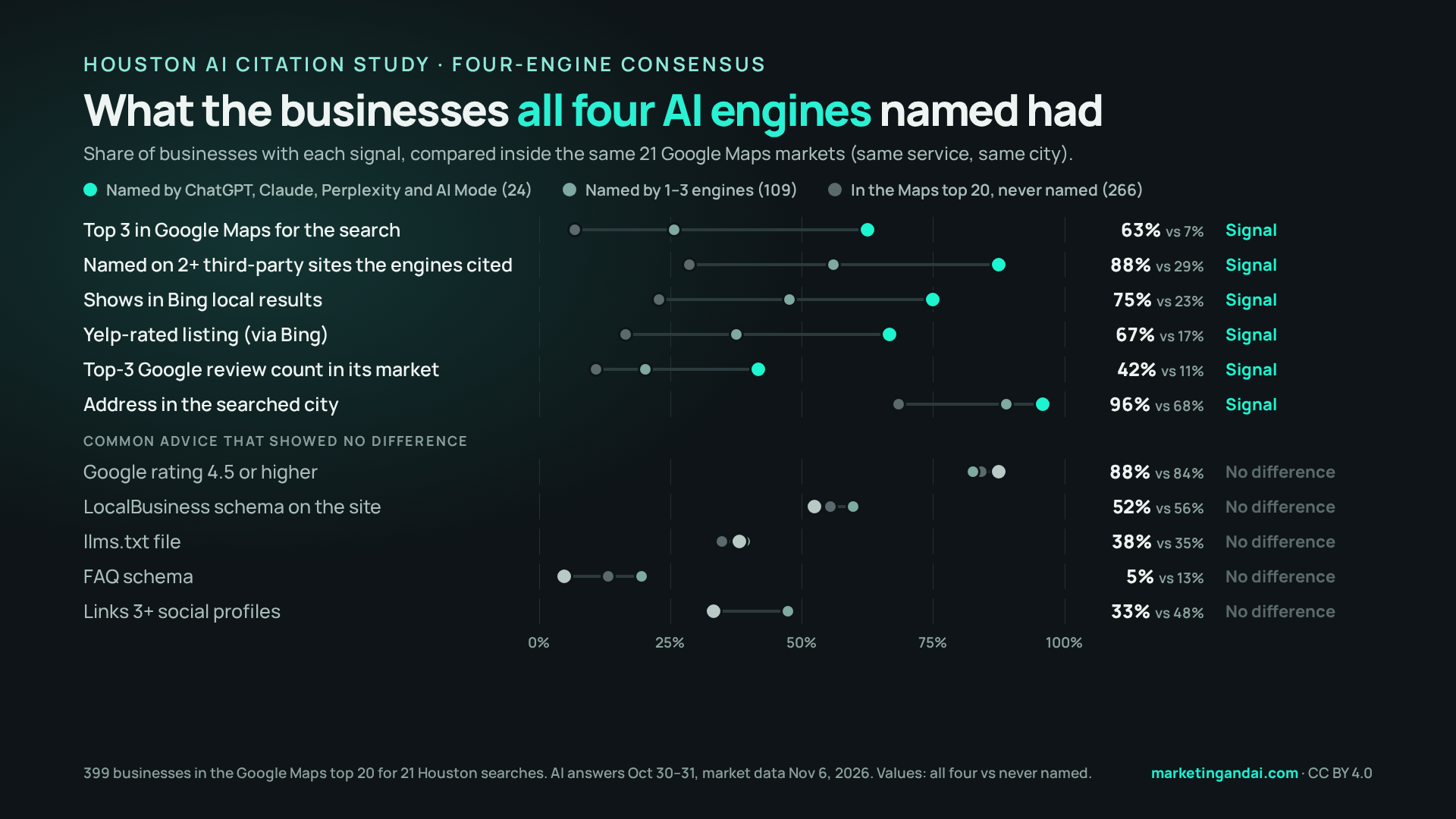
Share of businesses with each signal: top 3 in Google Maps 63% of businesses named by all four AI engines against 7% of never-named businesses in the same markets; named on two or more cited third-party sites 88% against 29%; in Bing local results 75% against 23%; Yelp-rated listing 67% against 17%; top-3 review count 42% against 11%. LocalBusiness schema, llms.txt, FAQ schema, a 4.5-star rating and social links showed no difference.
399 businesses in the Google Maps top 20 for 21 Houston searches. AI answers October 30–31, market data November 6, 2026. CC BY 4.0.
Signals among businesses named by all four AI engines, by one to three, and by none, in the same Google Maps markets
SignalAll four1–3 enginesNever namedOdds ratio (95% interval)Verdict
Top 3 in Google Maps for the search63%26%7%15.8 (6.4 to 39.0)Signal
Named on 2+ third-party sites the engines cited88%56%29%49.6 (10.9 to 226.6)Signal
In Bing local results75%48%23%11.1 (3.9 to 31.5)Signal
Yelp-rated listing (shown by Bing)67%38%17%14.6 (4.7 to 45.8)Signal
Google reviews (median)7673921962.5 (1.3 to 4.9) per SDSignal
Top-3 Google review count in its market42%20%11%5.1 (2.0 to 12.6)Signal
Address in the searched city96%89%68%16.1 (2.0 to 129.1)Signal
Google rating 4.5 or higher88%83%84%1.5 (0.4 to 5.8)No difference
LocalBusiness schema52%60%56%0.9 (0.4 to 2.3)No difference
Specific schema type (Dentist, Plumber...)38%45%41%0.8 (0.3 to 2.3)No difference
llms.txt file38%39%35%1.1 (0.4 to 3.1)No difference
FAQ schema5%20%13%0.4 (0.1 to 2.8)No difference
Links 3+ social profiles33%47%48%0.7 (0.3 to 1.9)No difference
Meta description91%88%86%3.8 (0.5 to 29.2)No difference
Wikidata item for the website17%11%11%1.6 (0.4 to 5.7)No difference
  • How to read this. The odds ratio compares businesses named by all four engines with businesses in the same market that no engine named (conditional logistic regression, one model per factor, so a plumber is only compared with plumbers in the same city). “Signal” means the factor also rose step by step with the number of engines naming a business, after correction for the 66 factors tested. Wide intervals reflect 24 cases. All 66 factors are in the downloadable table.

03 / The rough formula

Stack the signals
and the odds climb.

All 399 businesses, grouped by how many of the four signals they had.

Share of businesses named by AI engines, by how many of the four signals they had
SignalsBusinessesNamed by at least one engineNamed by all four
0 of 415113%2 (1.3%)
1 of 413630%0 (0.0%)
2 of 47256%7 (9.7%)
3 of 42976%10 (34.5%)
4 of 41191%5 (45.5%)
  • The four signals: a top-3 Google Maps spot for the search, a top-3 review count in the market, a mention on two or more cited third-party sites, and a place in Bing’s local results.
  • Together in one model, each still added odds: third-party sites 23.1 (3.9 to 137.8), the Maps top 3 8.0 (2.3 to 27.5) and Bing 5.3 (1.4 to 20.2). Review volume dropped to 3.3 (0.9 to 12.1) once Maps position was in the model, which fits reviews working partly through Maps rank.
  • 22 of the 24 had at least two signals, against 15% of never-named businesses. Lists alone were not enough: 74 never-named businesses were also on two or more of these sites.
  • Two had none. Clear Lake SEO is named after the search itself (“best SEO agency in Clear Lake”). Hellhound Gym Reloaded, a strength gym at #5 in Maps with 113 reviews, was on one cited site. The formula describes the usual path, and these are the exceptions we saw.

04 / By engine

Four engines,
four source problems.

All four signals helped with every engine (p under 0.03), but the weight shifted the way each engine’s October sources predicted.

Odds of being named by each AI engine with and without each signal, within the same Google Maps market
SignalGoogle AI ModeChatGPTClaudePerplexity
Top 3 in Google Maps7.2×3.8×6.0×5.2×
On 2+ cited third-party sites5.5×13.6×9.2×10.6×
In Bing local results4.0×6.1×6.5×4.1×
Yelp-rated listing (via Bing)3.6×5.6×7.1×4.6×
Top-3 review count in market3.1×3.5×2.1×2.9×
LocalBusiness schema1.2×1.3×1.1×1.4×
Wikidata item1.1×1.2×1.1×1.0×
  • Google AI Mode answers from Business Profiles: 96% of its October picks came with a profile card. It named businesses in the Maps top 3 49% of the time, others 11%.
  • ChatGPT leaned on directories and ranking sites (68% of its citations for “best” questions in October) and followed third-party lists hardest here.
  • Claude cited Yelp in 88 of 120 “best” answers in October and responded most to a Yelp-rated listing and a Bing local presence.
  • Perplexity splits between business websites (49% of its citations on recommendation questions) and directories (45%), and it cited the consensus pick’s own website in half of its mentions.
  • Schema type and Wikidata made no difference for any engine. Bold marks the engine where each signal mattered most.

05 / Entity or listing?

The 24,
one by one.

A well-known name helps, but 13 of the 24 were not review or brand leaders in their market.

The 24 businesses named by all four AI engines, with their Google Maps position, reviews and other signals
BusinessMarketTypeMapsGoogle reviewsReview rankCited sitesBingSignals
S & B PlumbingPlumber, Sugar LandEntity#11,70213yes4 of 4
Air Tech of Houston AC & PlumbingHVAC, HoustonEntity#16,67434no3 of 4
Joe I. Zaid & AssociatesInjury lawyer, PasadenaEntity#11,28525yes4 of 4
Hugo'sMexican restaurant, HoustonEntity#14,22356yes3 of 4
Christian Brothers Automotive The WoodlandsAuto repair, The WoodlandsEntity#21,82522yes4 of 4
Carmelo's Mexican GrillMexican restaurant, Sugar LandEntity#21,97263yes3 of 4
Sugar Land Pet HospitalVeterinarian, Sugar LandEntity#275924yes4 of 4
The Original Ninfa's on NavigationMexican restaurant, HoustonEntity#78,96716yes3 of 4
Michael Nugent DDSDentist, PasadenaEntity#1699422yes3 of 4
Lupe Tortilla Mexican RestaurantMexican restaurant, Clear LakeEntity#193,50622no2 of 4
PurA Medical AestheticsMed spa, HoustonEntity#2089326no2 of 4
Repair One Tire & AutoAuto repair, The WoodlandsListing#177473yes3 of 4
Daryl's DetailingCar detailing, HumbleListing#19044yes3 of 4
Clear Lake Medical SpaMed spa, Clear LakeListing#1136122yes3 of 4
Rejuvenation Laser Med Spa & Weight Loss CenterMed spa, PasadenaListing#113818yes4 of 4
Mike's PlumbingPlumber, The WoodlandsListing#264122yes3 of 4
VCA Animal Medical Center of PasadenaVeterinarian, PasadenaListing#260381yes2 of 4
Space City GymGym, HumbleListing#332372yes3 of 4
Advanced Pet Care of Clear LakeVeterinarian, Clear LakeListing#3190152no2 of 4
Hellhound Gym ReloadedGym, HumbleLists#511391no0 of 4
Life TimeGym, The WoodlandsLists#1332372yes2 of 4
Elite Medical Skin and Laser CenterMed spa, SpringLists#1343144yes2 of 4
Arnold & ItkinInjury lawyer, HoustonLists#141,27686yes2 of 4
Clear Lake SEO (Dale Ogden)SEO agency, Clear LakeLists–19120no0 of 4
  • Did they have the review-count edge? Fewer than you would expect. Only 3 of the 24 had the most Google reviews in their market and 10 were in the top 3. 20 of the 24 were above their market’s median, so the review count worked as a threshold more than a ranking.
  • Well-known entities (11): review or brand leaders, such as Hugo’s, The Original Ninfa’s, S & B Plumbing, Air Tech of Houston and Carmelo’s.
  • Well-structured listings (8): a Maps top-3 spot without the review lead. Daryl’s Detailing (90 reviews) and Mike’s Plumbing (64) were named by all four engines while competitors with up to 8 and 100 times their review counts were not.
  • Third-party consensus (5): outside the Maps top 3 and carried by lists. Arnold & Itkin sat at #14 in Maps and on six cited sites, including Best Lawyers, Expertise.com and Chron.
  • Maps = position for “[service] [city] TX” on November 6 (– = not in the top 20). Review rank = position by Google review count among the ~20 businesses in that market. Cited sites = third-party sites cited by any engine for that question that name the business (pages readable without a browser).

06 / How stable?

Consensus picks
stick around.

Share of October picks each engine named again when asked the same question: minutes later (all 120 recommendation questions) and seven days later (the 21 consensus questions).

Share of October picks each AI engine named again when asked the same question minutes later and seven days later
Re-askChatGPTClaudePerplexity
Minutes later: named by 1 in October40%63%80%
Minutes later: named by 2 in October66%74%84%
Minutes later: named by 3 in October73%77%86%
Minutes later: named by 4 (all) in October67%79%96%
7 days later: named by 1 in October33%50%45%
7 days later: named by 2-3 in October59%73%64%
7 days later: named by 4 (all) in October71%79%79%
  • Agreement predicts staying power. Across the three engines we re-ran, 81% of consensus picks were named again minutes later, against 61% of single-engine picks. Seven days later it was 76% against 43%.
  • Still, one check is a snapshot. Only 9 of the 24 were named by all three re-run engines on November 6, and ChatGPT kept a third of its one-off picks.
  • Google AI Mode was not re-run: our search API quota for November was used up.

07 / Seven more patterns

Seven more patterns,
in the same answers.

We went back to all 120 recommendation questions and the 399 businesses in these markets. Each pattern was checked for the most likely artifact, but they are follow-up findings: they were not part of the corrected 66-factor test.

  • 1. Maps #1 is worth far more than #3. 38% of businesses at #1 in Google Maps were named by all four engines, 25% at #2 and 10% at #3. Below the top 3 it was under 3%. Google AI Mode named 67% of #1 businesses and 40% of those at #2 and #3. The small rise at #11–20 is the list-carried picks.
Share of businesses named by AI engines, by Google Maps position
Maps positionBusinessesNamed by at least one engineNamed by all fourNamed by Google AI Mode
#12176%38%67%
#22070%25%40%
#32065%10%40%
#4–54055%2.5%25%
#6–1010035%1.0%15%
#11–2019716%3.0%5%
  • 2. The first name an engine gives is the one that holds. An engine’s first pick was also named by another engine 48–55% of the time, against 17–27% for its sixth pick or later, and the gap held inside the same answer. First picks also survived a re-ask: minutes later, Perplexity named its first pick again 96% of the time and its sixth-or-later pick 64%; Claude 82% against 31%; ChatGPT 64% against 32%. A pick that only ChatGPT made was kept 40% of the time. Track the position you are named in, not just whether you are named.
Share of each engine's picks also named by another engine, and named again minutes later, by position in the answer
Position in the answerShared: AI ModeShared: PerplexityShared: ChatGPTShared: ClaudeKept: PerplexityKept: ChatGPTKept: Claude
1st51%55%52%48%96%64%82%
2nd48%45%45%34%88%56%79%
3rd34%40%38%30%84%46%74%
4th–5th39%25%28%35%68%42%60%
6th or later–27%21%17%64%32%31%
  • 3. Website checks cannot predict a pick. We trained a model on 20 markets and asked it to pick out the named businesses in the 21st, once for each market. The score is how often a named business ranks above an unnamed one in the same market, so 0.5 is a coin flip. The 44 website checks scored 0.50, no better than the same model trained on shuffled labels. Seven Google Business Profile fields scored 0.77 for being named by any engine and 0.86 for all four.
How well each set of factors picks the named businesses in a market the model has not seen
FactorsNamed by any engineNamed by all four
44 website, schema and social checks0.50 (0.44 to 0.57)0.44 (0.33 to 0.54)
Link authority, domain age, Wikidata, chain, name0.56 (0.46 to 0.65)0.62 (0.50 to 0.73)
7 Google Business Profile fields0.77 (0.69 to 0.85)0.86 (0.74 to 0.94)
The four signals0.77 (0.74 to 0.81)0.88 (0.78 to 0.95)
The four signals without lists0.73 (0.67 to 0.78)0.86 (0.76 to 0.94)
Everything off the website (11)0.80 (0.75 to 0.85)0.85 (0.71 to 0.97)
Off-site plus the website checks (55)0.77 (0.72 to 0.82)0.91 (0.83 to 0.96)
  • 4. AI Mode is usually the last engine to agree. When ChatGPT, Claude and Perplexity all named a business, AI Mode joined them 42% of the time, against 52–63% for the others. It names fewer businesses per answer, and 5 of the 6 businesses in these markets named by every engine except AI Mode were outside the Maps top 3.
  • 5. Short lists turn into picks; long directories do not. On cited pages naming one to three of a market’s Maps top 20, 78% of those businesses were named by an engine and 33% by all four. On pages naming seven or more, it was 41% and 10%; businesses on no cited page, 13%. Birdeye (14 of 16), MapQuest (12 of 13) and Expertise.com (6 of 8) turned into picks most often, MedicalSpaLocator (7 of 26) least. The engines read these pages, so this is partly how a pick is made; it still shows where outreach pays.
  • 6. Franchise locations get passed over. With the same four signals, a chain or franchise location was less than half as likely to be named as an independent in the same market (odds ratio 0.40, 0.20 to 0.80), and it held with multi-location brands removed. Five of the eight never-named businesses with three or four of the signals were chain locations, including one market’s review leader and a Maps #1 med spa. One exploratory test, so read it as a lead.
  • 7. The engines agree on about one pick in five. When one engine named a business, any other given engine named it too 15–24% of the time. Agreement was highest in auto repair, gyms and veterinarians (27–30% of picks shared) and lowest for realtors (10%). Chiropractors, roofers, hair salons and realtors had no business named by all four engines in any of their eight areas.

08 / What to do

The consensus checklist,
in order.

Steps 1 to 4 are the signals that set the consensus picks apart. Steps 5 to 7 keep you in the running and make the result measurable.

  1. Rank in the Google Maps top 3 for “[service] [city]”. Set the primary Business Profile category to the exact service people ask about (23 of the 24 had it), and target the city your address is in: 23 of 24 consensus picks were located in the searched city, against 68% of never-named businesses. Keep hours, services, photos, the website link and review replies current. Aim for #1, not just the top 3: 38% of #1 businesses were named by all four engines, against 10% at #3. A franchise location needs more local proof than an independent with the same signals.
  2. Get named on at least two of the third-party pages the engines cite. Ask all four engines your most valuable questions and save every page they cite: that is your target list. In Houston it included Birdeye, BestProsInTown, Expertise.com, ThreeBestRated, Houston.com, Restaurantji, vertical directories such as Dental.me, Justia and Super Lawyers, and local press such as the Houston Chronicle and Eater. Short, curated “best [service] in [city]” pages turned into picks far more often than long directories.
  3. Claim Bing Places and Yelp. Bing Places can import your Google profile. On Yelp, a complete listing and a steady trickle of reviews mattered more than the score. Keep your name, address and phone identical on Google, Bing, Yelp and Apple Business Connect.
  4. Out-review the middle of your market. Compare your Google review count with the Maps top 20 for your search. Get above the median first, then into the top 3. Ask every satisfied customer; volume and recency counted, and the star rating did not.
  5. Keep the basics every contender already has. A website linked from your profile, AI search crawlers allowed in robots.txt and at the firewall, HTTPS, a sitemap, a meta description, a 4.5-star rating and 100 or more reviews. They did not set anyone apart, but missing one can take you out of the running.
  6. Then make your own site worth citing. Reviews, prices and years in business on the homepage, a specific schema type and a page for each city you serve. These went with being cited in the factor test, which matters most for Perplexity and AI Mode.
  7. Measure each engine separately, more than once. Ask each question at least three times on different days before calling a result, and count a win only when a business is named by all four engines on repeat asks. Record the position you are named in: first-named picks were the ones other engines shared and re-asks kept.

Skip, or put off, the advice that showed no difference here: llms.txt, FAQ schema, generic LocalBusiness schema, more social profiles and longer homepage copy. They may help other goals, but they did not separate the businesses all four engines named, and a model built on all 44 website checks could not pick the named business in a market it had not seen.

09 / Method

How we tested.

Every number on this page comes from the downloadable tables.

  • Answers: the 120 recommendation questions (“Who is the best [service] in [city], TX?”) from the Houston AI Citation Study, asked to Google AI Mode, Perplexity Sonar, ChatGPT search and Claude with web search on October 30–31, 2026. Businesses were matched across engines with the study’s name rules; one false merge of two different Katy chiropractors was split by hand, which reproduces the published count of 24.
  • Markets: for each of the 21 questions with a consensus pick, the Google Maps top 20 for “[service] [city] TX” on November 6, 2026 (399 businesses with the one consensus pick outside the top 20). Each business was labelled with how many engines had named it.
  • Factors: 66 per business: Business Profile rating, reviews, category, address and Maps position; the website linked from the profile, read without JavaScript (robots.txt, llms.txt, sitemap, content, schema, social and directory links); Bing local top 30 for the same search, including Yelp ratings; presence on the third-party pages the engines cited (174 of 289 readable without a browser); Common Crawl link authority; domain age; Wikidata.
  • Tests: conditional logistic regression within each market (consensus picks against never-named businesses), a within-market trend test against the number of engines naming a business, Benjamini–Hochberg correction across all 66 factors, a joint model of the four signals, and the same models per engine.
  • Stability: the October minutes-later re-runs, and the 21 consensus questions asked again on Perplexity, ChatGPT and Claude on November 6, 2026.
  • Follow-up patterns (section 07): naming rates by Maps position and review rank; agreement and re-ask survival by position in the answer, with a conditional logit within each question; leave-one-market-out logistic models scored by within-market concordance, with intervals from resampling markets and a shuffled-label test; cited pages grouped by how many of a market’s businesses they name; a chain indicator with the four signals held fixed, with and without multi-location brands. They are exploratory and not corrected for multiple testing.
  • Limits: one metro, 24 cases and wide intervals; these are associations, not proof that one change will move an engine. Being on cited lists is partly how engines reach a pick. Yelp, TripAdvisor, OpenTable and Yellow Pages pages could not be read without a browser, so list presence is undercounted for everyone. Follower counts and profile photos, posts and Q&A were not measured. Automated checks ran without JavaScript and were excluded from analytics.

10 / Data & citation

Use the numbers.

Free to reuse with attribution under CC BY 4.0. Values for the 375 other businesses are not published.

Download the factor table (CSV)

Cite as: Rusic, A. (2026). What gets a business named by all four AI engines? Houston AI Citation Study follow-up, November 2026. Marketing & AI. https://marketingandai.com/research/houston-ai-citation-study/ai-engine-consensus/

11 / Embed

Use the chart
on your site.

Free to republish under CC BY 4.0. The code below keeps the credit line that the license asks for.

Preview of the embeddable chart: what the businesses all four AI engines named had
Embed code (HTML)
<figure style="margin:0"><a href="https://marketingandai.com/research/houston-ai-citation-study/ai-engine-consensus/"><img src="https://marketingandai.com/images/houston-ai-engine-consensus.png" alt="What the businesses all four AI engines named had: top 3 in Google Maps, mentions on cited third-party sites, Bing local listings and review volume; schema, llms.txt and social links showed no difference" width="1920" height="1080" loading="lazy" style="max-width:100%;height:auto"></a><figcaption>Source: <a href="https://marketingandai.com/research/houston-ai-citation-study/ai-engine-consensus/">Houston AI Citation Study, Marketing &amp;amp; AI</a> (CC BY 4.0)</figcaption></figure>

Prefer a plain link? Cite as: Marketing & AI (2026). Houston AI Citation Study, four-engine consensus. marketingandai.com/research/houston-ai-citation-study/ai-engine-consensus/

Next / Your business

Find out which engines name you.

Check your site against the basics in about ten seconds, free, or book a 30-minute audit and we will show you where you stand on all four signals for your service and city.

Check my site free

Questions

About the four-engine picks.

How do you get a business recommended by ChatGPT, Claude, Perplexity and Google AI Mode?

In our November 2026 Houston study, the 24 businesses all four engines named usually had four things their competitors lacked: a top-3 spot in Google Maps for the search, mentions on two or more of the third-party sites the engines cite, a listing in Bing’s local results, and a review count near the top of their market. Businesses with all four were named by at least one engine 91% of the time.

Do schema, llms.txt or FAQ markup help a business get named by all four AI engines?

Not in this study. LocalBusiness schema (52% of consensus picks against 56% of never-named competitors), llms.txt (38% against 35%), FAQ schema and social links showed no difference. They can help a website get cited as a source, but they did not separate the businesses every engine named.

Does the number of Google reviews matter for AI recommendations?

Volume did and rating did not. Consensus picks had a median of 767 Google reviews against 196 for never-named businesses in the same markets, while the median rating was 4.8 stars in every group. Only 3 of the 24 had the most reviews in their market, so being above the market median mattered more than being the biggest.

Which sources does each AI engine use for local recommendations?

Google AI Mode answers from Google Business Profiles, so Maps position mattered most there. ChatGPT and Perplexity leaned on directories and ranking sites, and Perplexity also cites business websites. Claude leaned on Yelp, citing it in 88 of 120 “best” answers in October.

How stable are AI recommendations from one day to the next?

Less stable than one check suggests. A week after the first answers, ChatGPT, Claude and Perplexity named 76% of the consensus picks again but only 43% of picks a single engine had made. Ask each question several times on different days before acting on the result.

Does it matter where a business appears in an AI answer?

Yes. In our Houston data an engine’s first pick was also named by another engine about half the time, against 17–27% for its sixth pick or later, and first picks were the most likely to survive a re-ask: minutes later Perplexity named its first pick again 96% of the time. Track the position you are named in, not just whether you are named.

Project image

Open original image ↗